


Can You Live in Thailand Permanently as a Foreigner?
Yes, foreigners can live in Thailand permanently, but it requires the right visa or Permanent Residency (PR) status. Most long-term expats use renewable visas like the LTR Visa (10 years), Retirement Visa, Marriage Visa, or the Digital Nomad Visa (DTV), each with different income, age, or investment requirements. True PR status, which removes the need for any visa renewal, is available but hard to get: Thailand grants only around 100 PR permits per country per year.
Ever dreamed of swapping cold winters for sunny beaches and year-round flip-flop weather? I feel you! Living in Thailand permanently sounds like a dream, and it can be!
When we landed in Thailand in 2019 with a one-way ticket, we didn’t have a real plan. And finding the right visa, sorting out the paperwork, and figuring out a long-term setup wasn’t exactly smooth sailing.
But after a few visa runs and confusing applications, we finally cracked the code. Now, we have the perfect setup, and I want to share it with you.
Below are the realistic ways to stay long-term in Thailand. Let’s go.
Can You Permanently Live in Thailand?
Short answer? Yes! But also… not as easily as you might think.
Many foreign nationals assume they can just keep renewing their visas forever and call it “living in Thailand permanently.” But that’s not exactly how the Royal Thai Immigration Commission sees it.
After too many visa runs you’ll be denied entry. I saw many cases where this happened – even with families with young kids.
There’s a big difference between having long-term residence (staying on a visa that gets renewed regularly) and permanent resident status (where you no longer need a visa at all).
Long-Term Residence vs. Permanent Residency
- Long-Term Residence – This is what most expats do. They live in Thailand for years using visas like the Retirement Visa, Marriage Visa, or Long-Term Resident (LTR) Visa. But these visas need regular renewals and often come with financial requirements or reporting rules (hello, 90-day reports!).
- Permanent Residency (PR) – This is the golden ticket. With a PR permit, you don’t need to renew a visa, you can buy property more easily, and you can even apply for Thai citizenship later. But getting PR isn’t easy. It has strict requirements, a long approval process, and a very limited number of spots each year (Thailand only grants around 100 PR permits per country annually).
Common Challenges & Misconceptions
- “I’ll just stay on a tourist visa forever.” Nope. Immigration will catch on, and after a few visa runs, you might get denied entry.
- “Getting permanent residency is easy.” It’s not. The process takes years, and you need to meet strict criteria (like a high income, Thai language skills, and a long-term visa history).
- “Marriage to a Thai citizen means I can stay forever.” Not automatically. A Marriage Visa lets you stay long-term, but you still need to renew it every year.
Thailand Permanent Residence Permit (PR)
If you’re tired of visa renewals and want to make Thailand your forever home, Permanent Residency (PR) is for you. With PR status, you can stay in Thailand indefinitely: no more visa runs, no more 90-day reports, and way fewer headaches.
Benefits of PR:
- No need for visa extensions or border runs.
- You can buy a condo in your name (no need for workarounds).
- Easier to get a work permit and run a business.
- You can apply for Thai citizenship later.
- You can be a director of a Thai company.
- If you have Thai family members, PR makes life much simpler (easier visas for your kids, smoother legal processes).
Who is Eligible for Thai PR?
Thailand only grants 100 PR permits per country per year, so competition is tough. To qualify, you must already hold a Non-Immigrant Visa for at least 3 years and fit into one of these categories:
- Investment – If you invest at least 10 million THB ($280,000 USD / €260,000 EUR) in a Thai public company, real estate, or Thai government bonds, you’re eligible.
- Employment – You must have held a work permit for 3+ years, earned at least 80,000 THB per month ($2,250 USD / €2,100 EUR) (or 30,000 THB if married to a Thai), and have paid Thai taxes for three consecutive years.
- Family Ties – If you’re married to a Thai national or have Thai children, you can apply.
- Expertise & Contribution – If you have special skills, work in a priority industry, or contribute significantly to Thai society, you might qualify.
How to Apply for Thai PR?
The process takes time (and patience). Here’s what you’ll need:
- Work permits, income proof, and tax records (if applying through employment).
- Marriage certificate, birth certificates of Thai children (if applying through family ties).
- Investment proof (if applying through investment).
- Basic Thai language skills (yes, you’ll have to do an interview in Thai).
- Police clearance + medical certificate (standard for visa applications).
- A whole lot of patience – applications are reviewed only once per year, and it can take 1-2 years to get a decision.
How Much Does Thai PR Cost?
The PR application process isn’t cheap:
- Application fee: 7,600 THB ($220 USD / €200 EUR)
- Approval fee (if accepted):
- 191,400 THB ($5,500 USD / €5,200 EUR) for most applicants.
- 95,700 THB ($2,750 USD / €2,600 EUR) if married to a Thai national.
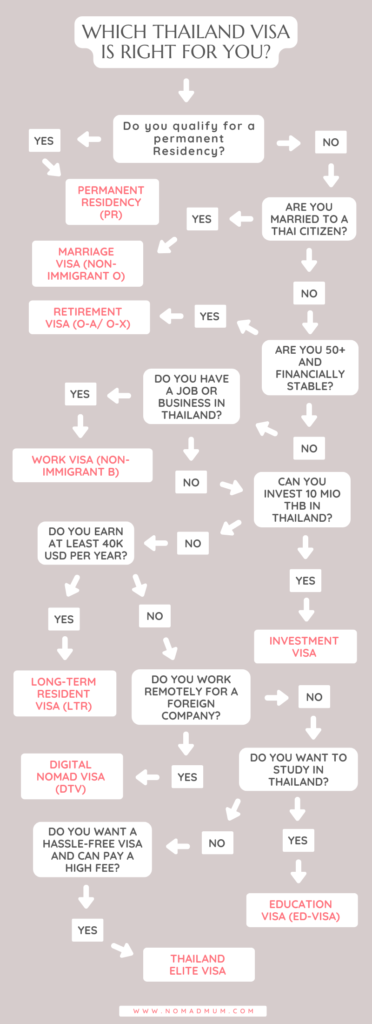
Long-Term Visa Options for Living in Thailand
Not ready (or eligible) for permanent residency? No worries! There are plenty of long-term visas that let you stay in Thailand for years, some even a decade, without the stress of constant border runs.
Here’s a quick overview in a table, followed by a detailed breakdown of each option.
1. Thailand Long-Term Resident (LTR) Visa
The LTR Visa is a simple way to stay in Thailand long-term. It’s valid for 10 years and comes with less paperwork. It’s available to four groups of foreigners:
- Wealthy Pensioners – Retirees aged 50+ need an income of $80,000 USD per year or $40,000 USD if they invest $250,000 USD in Thailand.
- Remote Workers – Must earn at least $80,000 USD per year from an employer outside Thailand. Those earning $40,000 USD need a Master’s degree or specialized skills.
- Highly Skilled Professionals – Scientists, researchers, and experts in key industries must earn $80,000 USD per year or $40,000 USD with a Master’s degree.
Benefits:- 10-year visa with multiple entries
- 90-day reporting reduced to once per year
- Includes a work permit, making it a good option for remote workers and business owners
- Flat 17% tax rate for certain professionals, lower than Thailand’s usual tax brackets
Cost: 50,000 THB (~$1,600 USD / ~€1,500 EUR) per person.
Best for those who meet the income or asset requirements and want a long-term stay with minimal paperwork.
2. Marriage Visa (Non-Immigrant O)
Foreigners married to Thai citizens can apply for a Marriage Visa, which allows them to stay in Thailand for one year at a time with yearly renewals.
Requirements:
- Legally married to a Thai citizen.
- Financial proof of either:
- 400,000 THB (~$11,000 USD / ~€10,000 EUR) in a Thai bank, held for at least two months before applying, or
- 40,000 THB (~$1,100 USD / ~€1,000 EUR) in monthly income. Other Conditions:– Must check in with immigration every 90 days.– Needs to be renewed each year.– A separate work permit is required to work in Thailand.
Best for foreigners married to Thai citizens who don’t qualify for permanent residency but want to stay long-term.
3. Retirement Visa (Non-Immigrant O-A or O-X)
Thailand offers two types of Retirement Visas for foreigners aged 50+ who want to live in the country without working.
Non-Immigrant O-A Visa
- Requires 800,000 THB ($22,500 USD / €21,000 EUR) in a Thai bank or a monthly income of 65,000 THB ($1,800 USD / €1,700 EUR).
- Must have health insurance covering 3 million THB ($85,000 USD / €78,000 EUR).
- Needs to be renewed every year.
Non-Immigrant O-X Visa
- Available only to citizens from 14 countries (including the USA, UK, Japan, and Australia).
- Valid for 10 years (renewed after 5 years).
- Requires 3 million THB (~$85,000 USD / ~€78,000 EUR) in a Thai bank.
- Must have health insurance with the same coverage as the O-A Visa.
Best for retirees who meet the financial and insurance requirements and want a long-term visa.
4. Investment Visa (Residence by Investment)
Foreigners can stay in Thailand long-term by making a significant investment in the country.
Requirements:– Invest at least 10 million THB (~$280,000 USD / ~€260,000 EUR).
- Investment options include government bonds, Thai property, or Thai companies. How It Differs from Permanent Residency (PR):
- PR is harder to get due to strict annual quotas and an interview process.
- The Investment Visa needs regular renewals, while PR does not.
Best for high-net-worth individuals who want a simple way to stay long-term.
5. Non-Immigrant B Visa (Work Visa)
For foreigners working in Thailand.
- Requires a work permit, sponsored by a Thai employer.
- Must be renewed every year with 90-day check-ins at immigration.
6. Smart Visa
For entrepreneurs, investors, and skilled professionals.
- Valid for up to 4 years.
- No need for a separate work permit.
Best for expats working for Thai companies or starting a business. However, I heard from some friends that this visa requires so much paperwork that it takes a lot of hard work and patience to obtain.
7. Digital Nomad Visa (Destination Thailand Visa – DTV)
Thailand’s DTV Visa is designed for digital nomads, freelancers, and remote workers earning income from outside Thailand.
Benefits:
- 5-year visa with 180-day stays per entry (can be renewed).
- No work permit needed for remote work.
- Lower financial requirements than the LTR Visa.
- Cost: 10,000 THB (~$270 USD / ~€250 EUR) per application.
Best for remote workers and freelancers who want a legal way to stay in Thailand long-term.

8. Privilege Visa (Thailand Elite Visa)
Thailand offers a long-term visa program with residency options ranging from 5 to 20 years, depending on the package.
Benefits:
- No need for visa renewals (only one visit at the immigration office per year, in case you don’t leave the country within 365 days).
- VIP perks, including fast-tracked immigration, airport services, and concierge support.
- Flexible packages, from 5 years to 20 years. Cost: Starts at 650,000 THB(~$19,500 USD / ~€16,900 EUR) for a 5-year visa.
We decided to go with this option, but more on that later.
Best for expats who want a hassle-free visa and are willing to pay for the convenience.
9. Education Visa (ED-Visa)
This visa is for those studying in Thailand, whether at a university, language school, or even a specialized program like Muay Thai.
Benefits:
- Valid for 3 months to 1 year, depending on the course.
- Can be extended as long as studies continue. Limitations:– Requires proof of enrollment in a Thai school.
- Immigration monitors attendance, so skipping classes can lead to cancellation.
- Does not allow legal work in Thailand.
Best for students, language learners, and budget travelers looking for a long-term stay without working.
Our Visa History and Best Practice
Arriving in Thailand with a Visitor Visa
We are German citizens, and when we moved to Thailand in 2019 with all our belongings, including our 2-year-old daughter, we first entered with a Visitor Visa on Arrival. Back then, it was only valid for 30 days (today, it’s a whopping 60!).
Switching to an ED Visa in Chiang Mai
In Chiang Mai, my husband signed up for a 6-month Muay Thai boxing course. That meant we had to travel to Ho Chi Minh City (basically a border run) to apply for an ED visa for him and dependent visas for my daughter and me at the Thai embassy.
Everything went smoothly, and we could finally stay in Thailand without stress. However, we had to visit the Immigration Bureau every three months for a 90-day report to confirm our address. These days, after the first in-person report, you can even do it online! Or, my favorite way, stay at a hotel every now and then and let them handle the 90-day report for you automatically.
The Elite Visa: Worth It or Not?
During COVID, Thailand luckily offered a free visa extension for stranded foreigners. But in 2021, we decided we didn’t want to visit Immigration so often anymore and needed a long-term solution. So, we bought a 5-year Elite Visa with multiple re-entry permit for our family.
It was a big investment (over €20,000 / $22,000 USD), but for us, it was worth it to finally stay in Thailand without constant immigration office visits. Also it made it possible for us to open a Thai bank account (something that’s hard to get for foreigners). The Elite Visa (also called Privilege Visa) has become much more expensive now. In my opinion, it’s no longer worth it. The new Digital Nomad Visa offers similar benefits, but for a much lower price.
💡 Check out the official Thai Immigration Website here.
Tax Obligations for Long-Term Residents
If you stay in Thailand for more than 180 days a year, you’re considered a tax resident and need to pay taxes on income earned in Thailand.
But here’s the good news. Foreign income isn’t taxed if you gift it to your spouse. That means if you keep your earnings abroad and bring the money into Thailand while transferring it to your legal spouse, you won’t owe Thai taxes on it (up to 20 Million THB per year). But there are a few rules; please speak to a legal consultant.
What You Need to Know About Thai Taxes:
- Income earned in Thailand is taxed on a progressive scale (5%–35%).
- LTR Visa holders in skilled professions pay a flat 17% tax instead of progressive rates.
- Thailand has tax treaties (DTAs) with 60+ countries, so you won’t be taxed twice if your home country has an agreement.
- No wealth tax or capital gains tax on personal investments, but business owners and employees must pay social security.
- If you run a business or work in Thailand, you may have VAT (value-added tax) obligations, depending on your setup.
Taxes can get complicated, especially if you earn in multiple countries. If you’re staying long-term, it’s worth talking to a tax expert. Denationalize.me helped us set up our international tax structure, and I highly recommend Christoph and his team.

Healthcare & Insurance in Thailand
Thailand has high-quality healthcare, with both public and private hospitals available across the country. Expats can get most medical services here, but the experience depends on whether you go public or private.
Public vs. Private Healthcare in Thailand
Both public and private hospitals provide affordable and high-quality care, but the experience is very different.
Public Hospitals
- Lower cost but long wait times.
- Basic care is good, but English-speaking staff may be limited.
- Available to expats under Thai Social Security (if working legally in Thailand).
- Best for minor treatments or emergencies in rural areas.
Private Hospitals
- Faster service with shorter wait times.
- Doctors and staff speak English.
- High-quality hospitals in Bangkok, Phuket, Chiang Mai, and Pattaya.
- More expensive. A single consultation can cost 2,000–5,000 THB ($55–$140 USD / €50–€130 EUR), and hospital stays can be very costly without insurance.
Best Private Hospitals for Expats
Some of Thailand’s private hospitals rank among the best in Asia and are a top choice for expats:
- Bumrungrad International Hospital (Bangkok) – Known for world-class care and international specialists. My husband and I both had surgeries here and it was the best hospital experience ever for both of us.
- Samitivej Hospital (Bangkok & Pattaya) – High-end private hospital with English-speaking staff.
- Bangkok Hospital (nationwide branches), Offers high-quality treatment across multiple locations. I gave birth to my second daughter at Bangkok Hospital Samui and can highly recommend it! Read about my personal birth experience here.
- Phuket International Hospital – Best choice for expats living in Phuket.
Should You Get Health Insurance?
Even if it’s not mandatory for your visa, having private health insurance is a good idea. Medical costs can add up quickly, and emergencies can get expensive. Options include:
- Local Thai insurance – Cheaper but may have lower coverage limits.
- International expat insurance – More expensive but covers treatment in multiple countries.
After having a 5-year travel health insurance with the German provider Hanse Merkur, we decided to switch to the Thai insurance company LUMA Health Insurance.
You can read all about my process of finding the right insurance plan in this article.
Check out these amazing hotels in Bangkok, or use the map below. 👇

What Is the Real Cost of Living in Thailand Long-Term?
One of the most common questions I get is whether Thailand is actually affordable for long-term living. The short answer: yes, especially compared to most Western countries.
A comfortable expat life in Thailand costs roughly $1,500-$3,000 USD per month for a single person, depending on location and lifestyle. Bangkok and Phuket sit at the higher end; Chiang Mai and Koh Phangan are noticeably cheaper. For a family of four like ours, budget somewhere between $3,000-$5,000 USD per month for a good quality of life with private school, private healthcare, and regular travel.
Here’s a rough monthly breakdown for one adult living comfortably:
- Rent (1-bed, good area): 15,000-30,000 THB ($400-$850 USD)
- Food (mix of local and Western): 10,000-20,000 THB ($280-$560 USD)
- Transport (scooter or rideshare): 3,000-6,000 THB ($85-$170 USD)
- Health insurance: 3,000-8,000 THB/month ($85-$225 USD)
- Utilities + internet: 2,000-4,000 THB ($55-$110 USD)
So is $1,000 a month enough? Technically possible in a small town or in Chiang Mai if you live like a local. But for a comfortable expat lifestyle with private healthcare and occasional travel, budget at least $1,500-$2,000 USD.
The Real Downsides of Living in Thailand Permanently
Thailand is genuinely wonderful, but I’d be doing you a disservice if I only sold you the dream. After years of living here full-time, here are the honest downsides nobody puts in the brochure.
- Visa stress is real. Even with a long-term visa, you’re never quite a permanent fixture. 90-day reports, annual renewals, financial requirements, it’s a recurring admin burden that expats from countries with easier immigration systems find genuinely exhausting.
- You cannot own land. As a foreigner, you can buy a condo in your own name, but land ownership is essentially off the table (you’d need a Thai company structure, which has its own complications). For people who dream of buying a house and a garden, this is a big deal.
- Language barrier for bureaucracy. Everyday Thai life is manageable without the language, but dealing with immigration, contracts, and government offices in Thai is genuinely hard. The PR application even requires a Thai-language interview.
- Heat, humidity, and seasonal flooding. Depending on where you live, the rainy season can mean flooding and disruption for several months a year. The heat and humidity take some getting used to, and some people never fully do.
- Limited democratic rights. As a foreigner, you cannot vote, cannot stand for public office, and have little legal recourse in certain disputes. Property and business laws are weighted toward Thai nationals.
- Cultural adjustment. The concept of ‘face’, indirect communication, and a very different sense of time can create friction in work and social settings, especially if you’re used to blunt Northern European or American directness.
None of these are deal-breakers for us. But going in clear-eyed means you’ll handle them better when they come up.
Key Takeaways
- PR status is rare: Thailand only grants ~100 Permanent Residency permits per country per year, and the approval process takes 1-2 years.
- PR approval fee: Up to 191,400 THB ($5,500 USD) if accepted, plus the 7,600 THB application fee upfront.
- Best budget long-term visa: The DTV (Digital Nomad Visa) offers 5 years with 180-day stays per entry, for just 10,000 THB (~$270 USD) per application.
- Retirement Visa finances: You’ll need 800,000 THB (~$22,500 USD) parked in a Thai bank account, or a monthly income of 65,000 THB.
- Tax residency kicks in at 180 days: Stay longer than that in a calendar year and you’re taxed on Thai-sourced income; foreign income gifted to a spouse has a different treatment.
- Foreigners can buy condos, but not land: Land ownership requires a Thai company structure, which comes with its own complications.
- Comfortable single expat lifestyle: Budget roughly $1,500-$2,000 USD per month; families of four should plan for $3,000-$5,000 USD.
Final Thoughts on Living in Thailand Permanently
Living in Thailand permanently is possible, but it takes planning. There’s no one-size-fits-all solution, and your best option depends on your goals, finances, and lifestyle.
It took us a few years to find the best type of visa for us. But I believe that if you’re serious about staying in Thailand long-term, you’ll find a way. If we managed it as a family of four, you can too!
Got questions about long-term stay options in Thailand? Drop them in the comments, and I’ll do my best to answer as quickly as possible!
Thank you for reading and for making me part of your day! Yours, Lulu
Frequently Asked Questions
Can a US citizen live in Thailand permanently?
Yes, US citizens can live in Thailand permanently. The most accessible long-term options are the Retirement Visa (O-A or O-X, for those aged 50+), the LTR Visa (for high earners or remote workers), and the Digital Nomad Visa (DTV). US citizens are among the 14 nationalities eligible for the 10-year Non-Immigrant O-X Retirement Visa, which requires 3 million THB (~$85,000 USD) in a Thai bank. True Permanent Residency (PR) is available to US citizens but is highly competitive, with only 100 permits granted per country per year.
Is $1,000 a month enough to live in Thailand?
$1,000 a month is technically possible in lower-cost areas like Koh Phangan or a smaller northern town if you live simply and eat mostly local food. But for a comfortable expat lifestyle with private healthcare, the occasional Western grocery run, and a decent apartment, budget at least $1,500-$2,000 USD per month. Bangkok, Phuket, and resort towns are noticeably more expensive.
How many PR permits does Thailand grant per year?
Thailand grants approximately 100 Permanent Residency (PR) permits per country per year. Applications are reviewed once annually, typically accepted between October and December. This strict quota makes PR highly competitive, and the approval process can take 1-2 years from application to decision.
How long do I need to hold a Non-Immigrant Visa before applying for PR?
You must hold a Non-Immigrant Visa for at least 3 consecutive years before you can apply for Permanent Residency. During those 3 years, you’ll also need to meet additional requirements depending on your category, employment applicants need a work permit and 3 years of Thai tax records; investment applicants need to show the qualifying 10 million THB investment; family applicants need a valid marriage certificate or proof of Thai children.
Do I need to speak Thai to get PR?
Yes, and this catches a lot of applicants off guard. The PR application includes a Thai-language interview conducted by immigration officials. You don’t need to be fluent, but you should be able to hold a basic conversation and understand simple questions. Many applicants take formal Thai language classes specifically to prepare for this step.
What happens if I overstay my visa in Thailand?
Overstaying your visa in Thailand results in a fine of 500 THB per day (up to a maximum of 20,000 THB). If you’re caught by immigration officials rather than leaving voluntarily, you can be detained, deported, and banned from re-entering Thailand for up to 10 years. Even short overstays go on your immigration record and can affect future visa applications, including PR.
Can foreigners buy property in Thailand?
Foreigners can buy a condominium in their own name in Thailand, as long as foreign ownership in the building doesn’t exceed 49% of total floor area. However, foreigners cannot own land directly. To buy a house with land, you typically need a Thai company structure or a long-term lease agreement (usually 30 years, sometimes extendable). PR holders have slightly easier access to property processes, but the land ownership restriction still applies.



2 Responses
Hiya, great blog! Would you suggest applying for your visa in Thailand – we plan on moving to Samui with our 6 year old daughter in next few months once a property sale goes through in the UK. As soon as it goes through we would like to leave straight away and start looking at schools in Samui, can we do this coming in on a tourist visa and then change whilst in Thailand.
Hi Tasha, thanks so much! From what I’ve heard, the Digital Nomad Visa is actually very easy to apply for. You can do it from your home country before entering Thailand, which makes things smoother. There’s also another option: once your daughter is enrolled in an official school like Windfield (where our two daughters go to), one parent can apply for a parent visa (I’m not sure of the official name right now). In general you can enter on a tourist visa and then apply later for your preferred visa option. Worst case: you need to do a visa run in between. But that’s easy and quick through Singapore or KL for example. 😉 Greetings, Lulu