

What Happens if a Foreigner Gives Birth in Thailand?
If you are having a baby in Thailand as a foreigner, you can choose a private or public hospital, pay a clear package price, and get very good medical care. Your baby will not automatically get Thai citizenship, but you receive a Thai birth certificate, and then apply for your baby’s passport and visa through your own embassy.
I did this with my daughter Ruby on Koh Samui and felt safe and well looked after the whole time.
Why I Chose To Have My Baby In Thailand
Actually, we were totally happy as a family of three. But life in Thailand as a family is just so much more carefree than having kids in Germany. And so we decided to have a second one.
When I got pregnant with Ruby during the COVID pandemic, it was clear right away: the baby would come in Thailand. Flying back to Germany to give birth? Not a chance.
What is it like to have a baby in Thailand? How can parents prepare for the delivery? What can they expect and what not?
Here is everything I know about giving birth in Thailand, and how it went for me. Let’s go!
Our Quick Picks
🏥 Compare hospital birth packages early and ask for the full price list in writing.
✈️ Planning to fly before or after birth? Read my Thailand with a Baby Guide for timelines and tips.
💊 Check what your travel or expat health insurance really covers for pregnancy and birth.

Prenatal Care In Thailand As A Foreigner
At the beginning of the pregnancy, we lived on the small island of Koh Tao. Since all services were heavily down during COVID and there was no midwife on the island, I only had one option: the General Hospital.
Unfortunately, the medical equipment there is so outdated that the doctor detected pregnancy at 6 weeks but no heartbeat at 8 weeks. So he then declared Ruby dead with a high probability.
You can hardly say anything worse to an expectant mother, can you? I wanted to be on the safe side and took the speedboat over to Koh Samui.
A friend had recommended Dr. Rapheephan. And here she gave me an immediate all-clear: Ruby’s heart was beating strongly, and the development was age-appropriate. Wow, such a relief!
Since I felt so comfortable with Dr. Rapheephan, I also had further screenings done there. Later, I changed to Bangkokhospital Samui because they had a combination offer.
I had the following screenings done:
- Regular Ultrasounds 2D/3D
- Screening for Down Syndrome
- Small and large glucose tolerance test
- Swabs, blood tests (honestly, I can’t remember the names of the routine lab tests)
I was used to a very clear screening plan in Germany. My doctor just told me what to do next, and that was it.
In Thailand it felt different. I had to keep track myself, and because our travel insurance (Hanse Merkur at that time, now we use Safetywing) didn’t cover pregnancy, we paid for everything out of pocket.
The doctors explained the next steps only when I asked, so I learned to speak up and double-check what each test was for.
💡 My tip: Actively ask what’s next (and how much it costs). Then, do your own research and find out whether the test makes sense in your eyes or not.
Is Thailand a Safe Place to Give Birth?
Yes, if you choose a reputable private hospital. Medical care is modern, infection rates are low, and staff are gentle and professional. I always felt in good hands.
Public hospitals are cheaper but can be crowded and not always ideal if you need English-speaking staff. If you want predictable birth care, I’d always choose private.
Choosing a Hospital or Birth Clinic in Thailand
In Thailand, foreigners are free to choose where they have their babies. There is a lot of competition. And since the Thais love price packages of any kind, you can compare them.
For us, it was important that the doctors had a good reputation, that the staff could speak a little English, that the technology was modern, and that the facilities for emergency care of newborns were available.
💡 My tip: Ask around, gather experience, schedule visits, and get to know the hospitals. In large hospitals, there are usually extra departments for foreigners with English-speaking staff.
We heard many good things about Bangkok Hospital Samui and decided on the Baby Delivery Package “Cesarean Section” with a Standard Room. Our first daughter was born by C-section in Germany because of a breech presentation.
In Thailand, once you’ve had a C-section, hospitals won’t allow a natural birth for the next baby.
Back in August 2021, our package cost around 69,000 THB ($1,860 / €1,720) if you had at least three or four checkups there before. It was a little more for us because an English-speaking resident joined the surgery.
Our doctor, Dr. Siwaporn Peerananrangsee, was wonderful: calm, gentle, and she spoke perfect English.
Packing the Hospital Bag for Giving Birth in Thailand
We knew in advance that Bangkokhospital is well equipped. As a welcome gift, there was a backpack with baby bottles, baby clothes, nursing pads, wet wipes, and cleaning materials for the baby (cotton pads, saline, eye drops). Therefore, I did not need much more.
This is what I took with me:
- 3 sets of comfy clothes for me
- 5 comfortable panties
- Hygiene items
- Smartphone, including charger and headphones
- 1 set of newborn clothes
- Healthy snacks such as nuts, granola bars, and dried fruit
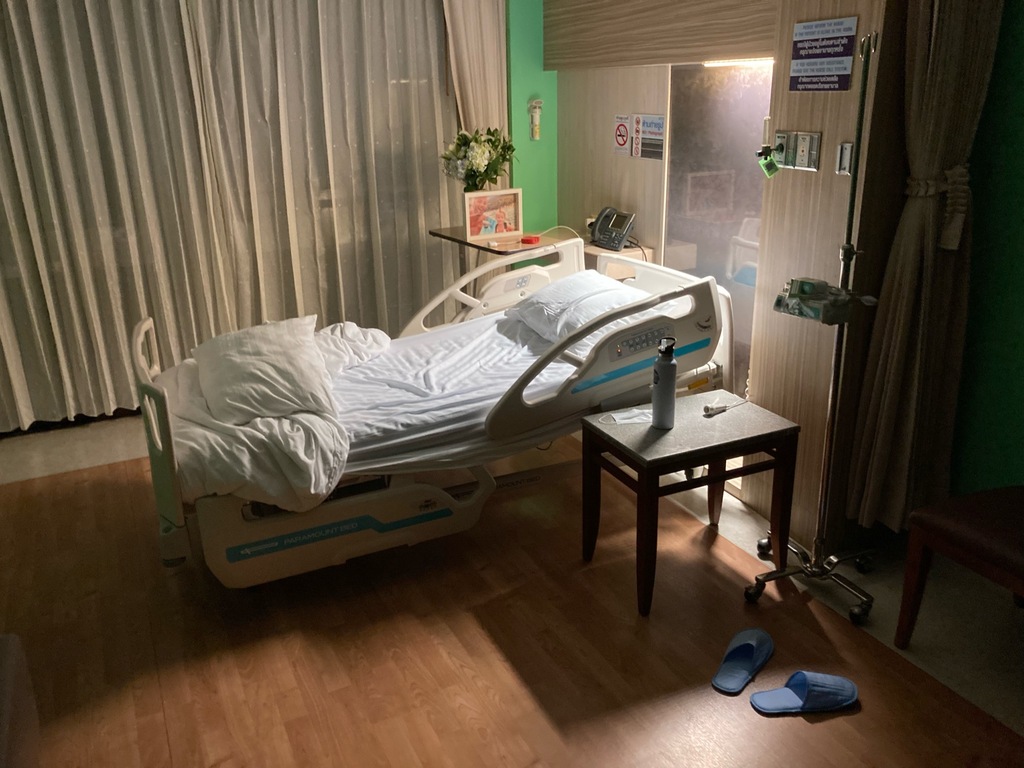
💡 My tip to men: Bring your wife something personal so she’s not so alone. My husband framed a picture of himself and our daughter and got a big bouquet of flowers. I always looked at this ‘altar’ when I was feeling anxious or overwhelmed.
The Day of Birth
The pregnancy went smoothly, and Ruby was born on August 18. The day before, the doctor asked me to stay overnight for monitoring, so my last night without a baby was almost sleepless.
A nurse came in every four hours to check my vitals. If a hospital suggests this to you, ask if it’s truly necessary. You can say no.
The next morning, a nurse arrived at 6 am to shave me and give an enema. Then I waited until they wheeled me into the OR at 9 am, completely sober and soooo nervous.
Because of COVID rules at the time, my husband wasn’t allowed in the operating room. He took our older daughter to school and reached the hospital around 10 am.
Ruby arrived only twenty minutes after I entered the OR. The resident stood by my head the whole time and talked to me gently. It helped a lot to have someone there when my husband couldn’t be.
💡 My tip: Be sure to tell the staff immediately if you are not feeling well in any way. For example, I had a slight feeling of nausea at the beginning. The doctor immediately gave me anti-nausea medication.
After they showed me the baby and I got to kiss her, they put me into a light sleep. I didn’t hear anything while they finished the stitching. Around 10 a.m., they brought me back to my room, where my husband was waiting. About 30 minutes later, Ruby was placed in our arms.
The Hospital Stay after Delivery
I stayed in the hospital for three nights after the birth, and it was honestly great. I was the only mum with a baby on the whole ward, so the staff checked on me all the time. Whenever I pressed the nurse button, someone came right away.
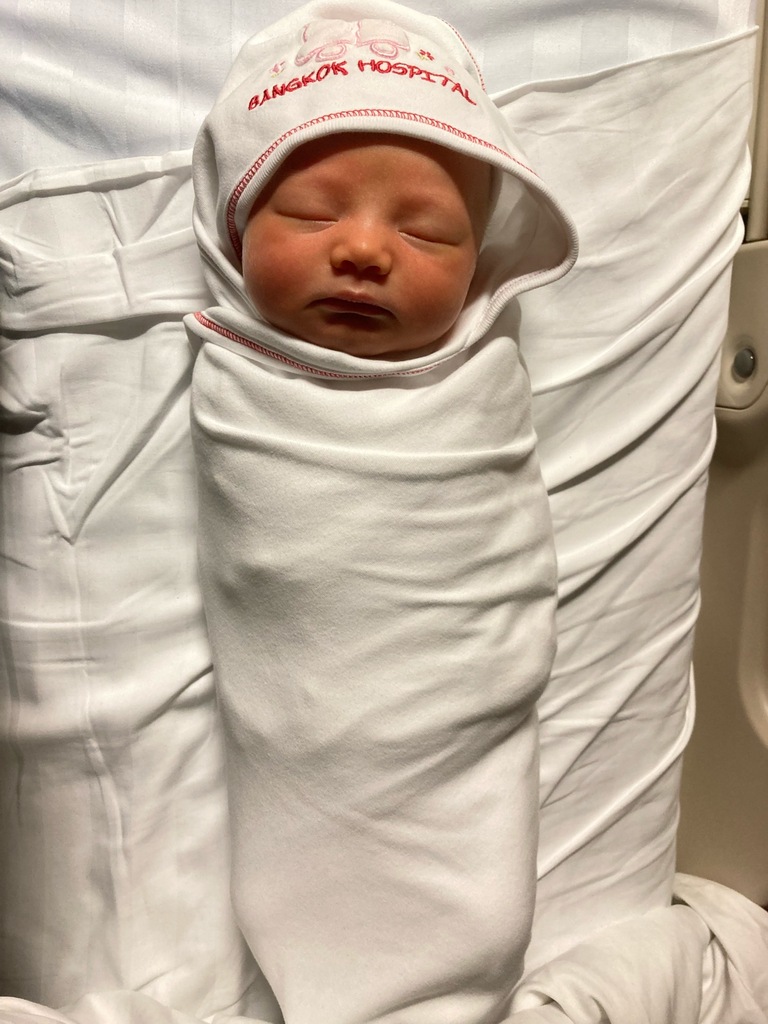
I could ask them to swaddle Ruby any time, which is amazing when you can’t get out of bed yet. At night, they even took her so I could rest. They only brought her in every few hours to breastfeed. By the second night, as the medication wore off and my appetite came back, I didn’t want to be without her for too long.
💡 My tip: Don’t be shy and ask for painkillers. You don’t have to suffer when giving birth in Thailand. A nurse even told me at the end that a mother before me had been given morphine. If I had known that earlier…
I’ve heard from many families that the husbands stayed overnight in the room, sometimes even with their other kids. For us, that didn’t feel right. One tired parent was more than enough.

Citizenship, Visas and Paperwork: Babies Born in Thailand Benefits
In Thailand, citizenship is based on blood. So if both parents are foreigners, the baby won’t get Thai citizenship. At least one parent has to be Thai to apply.
In our case, the hospital made everything very simple. A nurse arranged the Thai birth certificate for us and handed it over on the last day, including a free English translation.
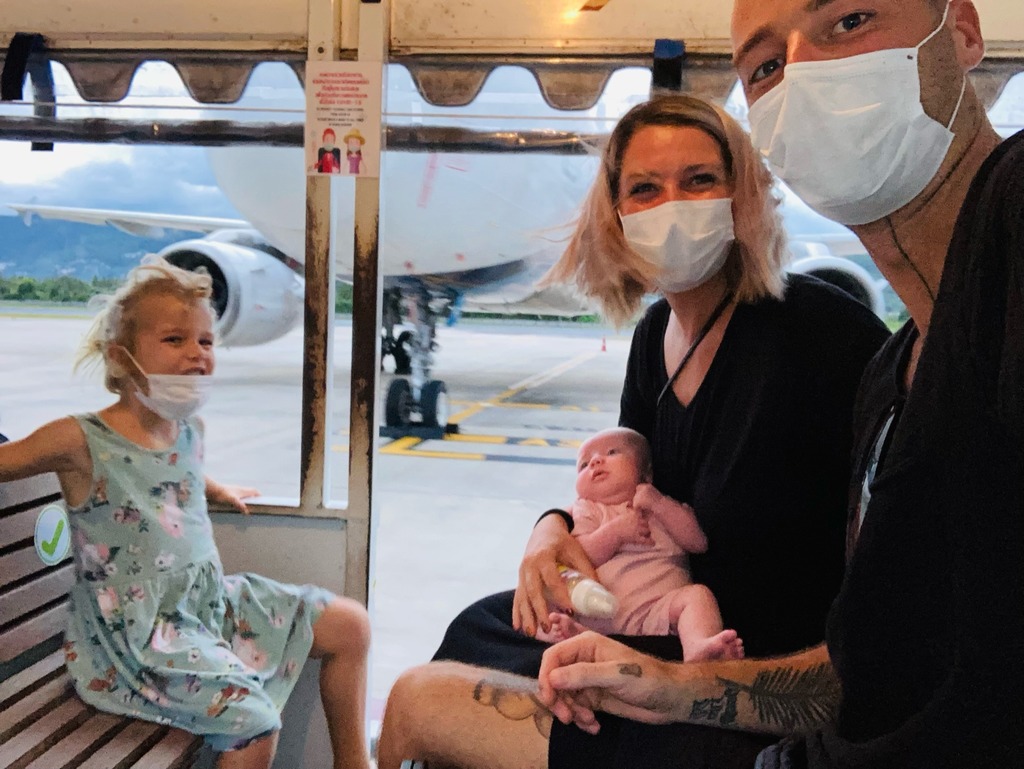
Because we planned to fly to Europe a few months later, we used these documents to apply for a German passport for Ruby at the embassy in Bangkok.
Inside Thailand, the Thai birth certificate works as an identity document for a long time. We even met families with 3- or 4-year-olds who still used it to fly domestically.
Good to know
- We decided to store stem cells from the placenta and cord blood, just in case Ruby or someone in our family ever needed them in the future. We had to arrange and pay for everything a few weeks before the birth. Our partner was Medeze in Bangkok. It’s an interesting option if you believe in science and have the budget for it.
- During pregnancy, get ready for some unusual advice. One doctor told me to eat 12 eggs a day to keep my blood levels healthy. I managed six, and even that felt like way too much.
- Privacy is different here, too. People often touched my belly and guessed the gender. I didn’t mind, and funny enough, almost everyone guessed correctly that it was a girl.
- If your baby has typical Western measurements, they will seem huge by Thai standards. And people will tell you many times. Don’t take it personally. I had to laugh about it in the end.

Baby Delivery Options: Why Thailand Encourages C-Sections
C-sections are very common in Thailand, and there are many reasons for it. Part of it is habit, part of it is culture, and part of it is simple convenience.
Many mums and doctors like having a set date. It feels safe and predictable, and private hospitals make the whole process very comfortable. Because of that, a planned C-section often becomes the standard choice.
Of course, C-sections are important when they are medically needed. But the WHO recommends a much lower rate than what some hospitals in Thailand actually have. So it is natural to wonder if every C-section is truly necessary.
In the end, the high rate comes from modern medical trends, personal preferences, and the luxury birth experience that many private hospitals offer.
Home Birth and Water Birth in Thailand
Years ago, midwives were the main support for childbirth in Thailand. This changed in the 1970s when the government focused on improving healthcare. Hospital births became the norm, and home births slowly disappeared except in some remote areas.
Most licensed midwives now work in hospitals, so the classic home birth scene is very limited. For foreign midwives, it is almost impossible to work here because they would need to pass difficult exams in formal Thai and follow strict regulations. Finding a licensed foreign midwife in Thailand is very rare.
The good news is that doulas are available, and they seem to be wonderful. I know several women on Koh Phangan who had lovely home births with a doula. It takes more planning, but it is possible.
Statistics Around Childbirth in Thailand
Thailand has a birth rate of about 13 babies per 1,000 people. Maternal deaths are rare, and when they happen, they are usually linked to bleeding, infections, high blood pressure, or other medical complications.
Almost all Thai women who give birth receive professional medical care. The rate is about 97 percent, which is much higher than in many nearby countries.
Most Thai women also get regular prenatal checkups. Around 74 percent have at least four visits during pregnancy, and many use birth control.
Child health has improved a lot. Deaths before age five dropped from 28 to 14 per 1,000 births in just six years. Infant deaths also went down from about 20 to 16 per 1,000 births.
Traditional Thai Pregnancy Beliefs and Abortion Laws
Pregnancy in Thailand comes with many traditional beliefs. Some people say life begins when a soul enters the womb. Missing your period and craving sour food are seen as early signs of pregnancy. Once you know, it is common to tell your partner, your mother, and your mother-in-law first.
Infertility is often viewed as a problem of imbalance. Some believe acupressure can help bring the body back into harmony.
Buddhism also shapes how pregnancy and abortion are seen. Abortion is considered serious because it interrupts the cycle of rebirth. Since 2021, abortions are legal in the first 12 weeks and in a few specific situations, such as health risks or pregnancies caused by violence. Before that, some women used unsafe methods.
👉 You might also like:
– Top 4 Baby Headphones for the Plane
– Thailand Family Itinerary
– 35 Interesting Facts About Thailand
Pros and Cons of Giving Birth in Thailand as a Foreigner
Pros
Giving birth in Thailand is calm, personal, and often more comfortable than in Western countries. Private rooms, kind staff, and clear birth packages make everything easy. The postpartum period is especially relaxing with sun, affordable help, and warm weather.
Cons
Insurance doesn’t always cover pregnancy, so costs can be much higher than at home. English in public hospitals can be limited. And because Thailand encourages C-sections in many private clinics, you may need to advocate more clearly for a natural birth if that’s your preference.
Key Takeaways
- Thailand is a safe and comfortable place to give birth, especially in private hospitals.
- Babies born to foreign parents don’t get Thai citizenship but receive a Thai birth certificate.
- Birth packages make costs predictable, though insurance may not cover pregnancy.
- Home and water births exist but are less common and need extra planning.
- Overall, I recommend giving birth in Thailand a 100%!
Conclusion on Giving Birth in Thailand
I found giving birth in Thailand much more pleasant than my delivery in Germany. Yes, a C-section always comes with pain, but I never felt unsafe or treated differently as a foreigner.
The postpartum time in Thailand was wonderful. I healed so much faster with sunshine, warm weather, and the sea nearby. If you have the chance, I would definitely recommend it.
If you have any questions, just leave a comment. I am happy to help.
Thank you for reading and for making me part of your day. Yours, Lulu
FAQ on Giving Birth in Thailand as a Foreigner
Is Thailand a good place to give birth as a foreigner?
Yes. If you choose a reputable private hospital, the care is excellent, staff usually speak English, and birth packages are very clear. I felt much calmer and more supported in Thailand than during my first C-section in Germany.
Is it safe to travel to Thailand while pregnant?
In general, yes, but I’d only come if your pregnancy is low-risk and your doctor at home agrees. Avoid very remote areas late in pregnancy and always check current advice about mosquitos, Zika and dengue. Personally, I wouldn’t fly here in the first trimester just for a holiday.
What are the benefits of having a baby in Thailand?
You get modern hospitals, kind staff, clear package prices and a very relaxed postpartum period in the sun. Many private hospitals include a private room, baby supplies and lots of nursing support, which made healing much easier for me.
Can my baby get Thai citizenship if born in Thailand?
No, not if both parents are foreigners. Thailand uses “right of blood”, so at least one parent must be Thai. Your baby will get a Thai birth certificate, and then you apply for a passport from your own country.
Does a baby born in Thailand get any long-term visa or residency rights?
Not automatically. A Thai-born foreign baby can stay in Thailand on the same visa type as the parents. You still need to sort normal visas and extensions through immigration.
How much does it cost to give birth in Thailand as a foreigner?
It depends on the hospital and the city. Package prices for uncomplicated births in private hospitals usually range from mid five-figures to low six-figures in Thai Baht for vaginal birth, and more for C-sections. My C-section package on Koh Samui was around 69,000 THB because I had several checkups there before.
What is the difference between public and private hospitals?
Public hospitals are much cheaper but often crowded and with less English spoken. Private hospitals are more expensive but offer shorter waiting times, private rooms and more support in English. As a foreigner, I’d always choose private for birth if you can afford it.
Can I have a home birth or water birth in Thailand?
It’s possible, but not mainstream. Most licensed midwives now work in hospitals, and true home births happen more in small expat communities or remote areas. I know mums on Koh Phangan who had beautiful home and water births with doulas, but you need to research carefully and accept more responsibility.
What are Thai traditions around pregnancy and birth?
There are lots of sweet and sometimes funny beliefs: people guess the baby’s gender by the size of your belly, many doctors push eggs for “strong blood”, and some families believe pregnant women shouldn’t go to funerals. I tried to relax and enjoy it, even when everyone told me my 3.6-kilo baby was a “giant”.
How do I organise the birth certificate and baby’s passport?
Your hospital can usually help you apply for the Thai birth certificate and even the English translation. After that, you make an appointment at your embassy in Bangkok (or sometimes Chiang Mai/Phuket) to apply for your baby’s passport. In our case, the hospital handled almost everything and we picked up the passport on a short trip to Bangkok.



9 Responses
Your positive and uplifting words are like a ray of sunshine on a cloudy day Thank you for spreading light and positivity in the world
Your words have a way of resonating deeply with your readers Thank you for always being encouraging and uplifting
Thank you, Quincy! That means a lot!
I loved how insightful this is! Thailand sounds like an amazing and healing place to have a baby. I have a question: What is the Thai’s perspective on Zika and impacts on pregnancy? Here in the West, there is a lot of fear mongering (though, some is rooted in truths about the impacts of Zika). How much is it a concern there?
Thank you so much, Becca, for your lovely feedback! Yes, Thailand truly is a beautiful and healing place to have a baby. That said, I completely understand your concern about Zika. A friend of mine wanted to visit this year but found out she was pregnant. I actually advised her against coming. It’s definitely a concern here among expectant moms, and local doctors strongly recommend avoiding mosquito bites at all cost (which is quite difficult, depending on where you live).
Even though I had my pregnancy here (I was also “stuck” in Thailand during COVID), I wouldn’t actively suggest traveling here while pregnant, especially in the first trimester. I hope I could help. 🙂
That is helpful! Is there areas to avoid to reduce mosquito risk? I was planning to come in January for 2 weeks to Phuket/Krabi/Bangkok which my doctor hasn’t advised against, but want to reduce exposure as much as possible,
Hi Becca,
I’d say, in general, try to stay away from mosquitos as much as possible. Bangkok is the lowest risk anyway. That’s perfect! For Phuket and Krabi, choose breezy coastal areas or places close to the beach. Avoid jungle interiors, still ponds, or dense vegetation, especially around sunrise and sunset when they’re most active.
I know many people don’t like it, but I always use mosquito spray with DEET in Thailand, the one from 7-Eleven with the pink cap works best for me! I’ve found that Thai mosquitos aren’t really bothered by the natural repellents with citronella and the like. 😉
So happy to see your post about giving birth in Thailand. I am in a very similar situation now, living on Koh Tao, and heading to Samui for my first appointment. Quick question: did you keep going back and forth from Tao to Samui for every appointment? If you went back to Tao after birth, how long after? Or did you feel the need to stay in Samui for a few weeks after baby is born?
Hi Nayara, sorry for the late reply. Congratulations to your pregnancy! 😀 Yes, I kept going back and forth for every appointment. I felt so comfortable with the doctor in Samui and didn’t want to change that. 4 months after giving birth in Samui we flew to Europe so the grandparents could meet the baby. Afterwards we moved to Koh Phangan. But honestly, I think it’s totally fine to go back to Koh Tao after 2 months or so…it totally depends on how YOU feel and how you’re healing. 🙂 I personally enjoyed the comfort and infrastructure in Samui with a newborn.