


How Do You Find a Nanny in Thailand as an Expat Family?
Finding a nanny in Thailand comes down to three main routes: posting in expat Facebook groups (the Thailand Expat Nanny Finder group is the largest), using a local platform like Kiidu, or going through a Bangkok-based nanny agency. Word-of-mouth from other expat families is still the most trusted method. Agencies cost more but are worth it when you are brand new to Thailand and have no personal network yet. Before you search, get clear on your needs: live-in or live-out, hours, languages, and how much you can pay locally. That clarity saves a lot of time.
Finding a nanny abroad comes down to three main routes: asking around in person for local recommendations, posting in expat Facebook groups, or going through a local or international nanny agency. In Southeast Asia, Facebook posts and word-of-mouth have consistently worked best for our family across Thailand, Indonesia, and Vietnam. Agencies cost more but are worth it when you are brand new to a country and have no network yet.
Let me say up front: in my opinion, no one should have to justify hiring a nanny abroad. You do not have to work full time to have the right to time without children. But how do you actually find a nanny abroad as a Digital Nomad Family? How do you overcome language barriers, and what is truly essential? We have had long-term nannies, short-term babysitters, women from agencies, and those who were recommended to us privately. Below I have gathered everything I have learned from Thailand, Indonesia, and Vietnam.
Brainstorming: What Do You Actually Want?
Before you start actively searching, you should be clear about your needs. Answering these questions first will save you enormous time and prevent mismatched expectations later.
- When should the nanny come, and are you flexible on timing?
- Will the nanny live with you or return home at night (live-in or live-out)?
- What are your preferences on age, gender, and nationality, and remember to check work permit requirements for foreign nationals?
- What experience should the nanny bring? Is a young woman who loves children enough, or do you need a trained educator or former au pair?
- How important are references and recommendations from previous employers?
- Which languages should the nanny speak?
- How much can you spend per month? Research local rates before you post any job ad.
- Should there be a trial period?
- How far in advance are you willing to pay, one month upfront, or week by week?
- Should the nanny also handle household tasks?
- How long should the employment last?
Getting clear on all of this before you post a single message makes every step that follows much easier.
How Much Does a Nanny Cost in Thailand?
This is usually the first question families ask, and the honest answer is: it depends a lot on location, hours, and whether the nanny lives with you. That said, here are the realistic ranges you should be budgeting for in 2026.
For a local Thai nanny working part-time (around 4-6 hours per day), expect to pay somewhere between 10,000 and 15,000 Thai Baht per month. For full-time live-out arrangements, 15,000 to 25,000 Baht per month is a fair range in cities like Bangkok or Chiang Mai. Live-in nannies, where you provide accommodation and meals, typically cost less in cash terms, anywhere from 12,000 to 18,000 Baht per month, because the accommodation is considered part of the package.
On islands like Koh Samui or Koh Phangan, rates can be slightly lower than Bangkok, but experienced English-speaking nannies command a premium everywhere.
If you go through an agency, add a placement fee on top, typically one to two months of the nanny’s salary. That is the cost of the vetting and the replacement guarantee.
My tip: Before posting any job ad, research the going rate in your specific city or island. Offering too little wastes everyone’s time. Offering fair pay from the start builds loyalty from day one.
Where to Search for a Nanny in Thailand: The Best Platforms
Once you know what you need, the search begins. In Thailand, these are the channels that actually work.
Facebook Groups are still the number one tool for expat families in Thailand. The group Thailand Expat Nanny Finder is the largest and most active community for exactly this purpose. Search for expat groups specific to your city, Bangkok Expats, Koh Phangan Families, Chiang Mai Expats, post clearly, and filter applicants carefully before meeting anyone in person.
Kiiduis a Thailand-based platform that screens nannies, maids, tutors, and caregivers in Bangkok and surrounding areas. It is a step up from a raw Facebook post because candidates are pre-vetted. If you are based in Bangkok and want more structure than a Facebook group provides, Kiidu is worth trying.Word of mouthshould not be underestimated. Ask at your kids’ school, your local coffee shop, your neighbors. In Thailand, personal referrals carry enormous weight, and a nanny who comes recommended by someone you trust is worth more than any platform screening.Local agencies in Bangkok, such as Bangkok Nanny Center and similar services, offer structured placements with contracts and replacement guarantees. They cost more, but for newly arrived families with no network, that fee buys real peace of mind.
My tip: Combine at least two methods. Post in a Facebook group AND ask around locally at the same time. The Facebook post casts a wide net; the word-of-mouth search catches the person who was not even looking for a new job but turns out to be perfect for yours.

How to Search for a Nanny in Thailand: Comparing Your Options
There are numerous ways to find a nanny, and of course there are large regional differences. In Thailand, Indonesia, and Vietnam, two methods have worked best for us: asking around in person and making Facebook posts.
Both have real advantages and disadvantages. Asking around in person is more time-consuming, but personal recommendations are precious. Facebook posts are quick to write, and you have everything in black and white, you can scan every applicant online before meeting anyone. The significant disadvantage: no matter how an applicant presents themselves online, you do not always know exactly who you are dealing with or to whom you have given your personal data.
And then there are babysitting agencies. These are professional companies that provide well-trained staff by the hour. More expensive, yes, but also practical. These nannies often bring their own toys and have solid pedagogical knowledge.
| Method | Pros | Cons | Typical Cost |
|---|---|---|---|
| Facebook groups | Fast, wide reach, free to post | No vetting; you manage all screening | Free |
| Word of mouth | High trust, personal reference | Slower, limited to your network | Free |
| Kiidu / local platforms | Pre-vetted candidates, structured | Smaller pool; Bangkok-focused | Low platform fee |
| Local agency | Screened, contracts, replacements | Higher cost | 1-2 months’ salary placement fee |
My tip: Combine personal and online searches. This will increase your chances of finding the perfect nanny abroad.
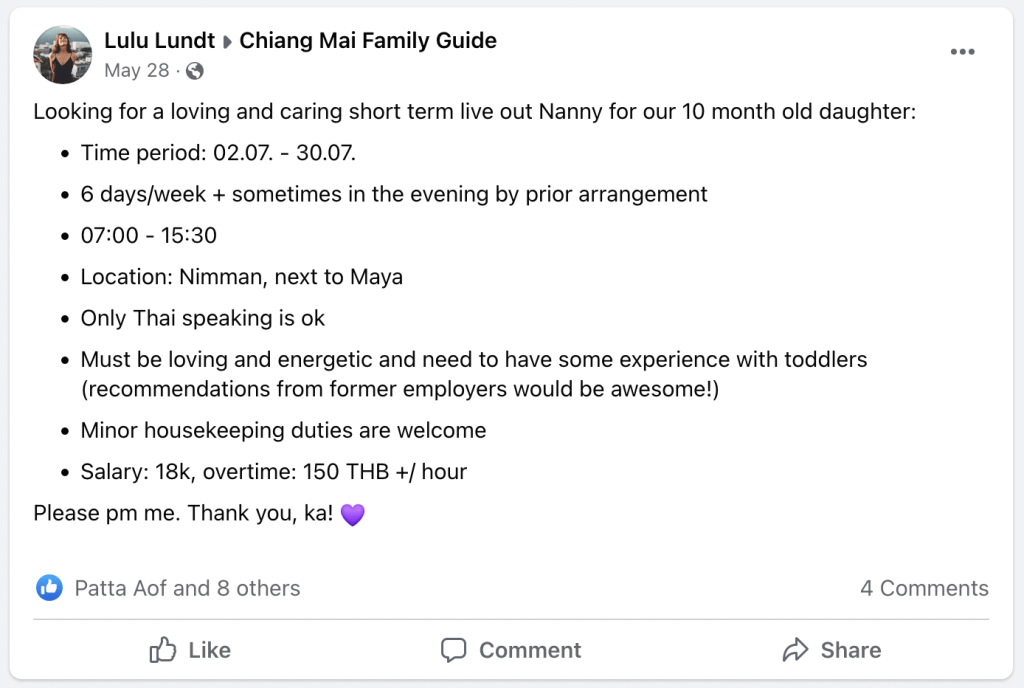
Nanny vs. Au Pair Abroad: Which One Is Right for Your Family?
I get this question a lot. Worth sitting with before you start looking.
An au pair is typically a young person who lives with your family, helps with childcare in exchange for room, board, and a small stipend, and is officially part of a cultural exchange program. A nanny, on the other hand, is a professional childcare worker you pay a proper wage.
In Southeast Asia, the au pair model barely exists. What you find instead is a spectrum: paid nannies, babysitters hired by the hour, and private helpers who do a mix of childcare and household tasks.
In Europe, Australia, or Canada, au pair programs are formal and well-regulated. If you are based there or traveling through, an au pair might be a cost-effective option. If you are in Asia, hire a nanny. The structures are just different.
International Nanny Agencies and Online Platforms
Agencies are the most reliable route when you are new to a country and have no personal network yet. They screen candidates, verify references, and often provide replacement guarantees if things do not work out. Yes, they cost more. But the peace of mind can be worth every baht.
Some families swear by international agencies like The Nanny Authority or Cultural Care for structured placements. For those of us living nomadically in Southeast Asia, local agencies in Bangkok, Bali, or Ho Chi Minh City tend to be more practical and affordable.
Beyond agencies, Facebook groups remain the most underrated tool in this part of the world. Care.com is widely used in Western countries and can be useful if you are heading to the US, UK, or Australia. For Southeast Asia, local Facebook groups and word-of-mouth still win.
Getting to Know the Candidates
When you have put together a shortlist of possible candidates, invite them over and get to know them in person. It was always important to us that the whole family was there. If anyone in the family has a bad feeling about it, that is your answer. You also want to see whether the future nanny gets along with all family members. A baby-crazy woman does not help anyone if she cannot connect with the five-year-old.
My tip: Let the candidate come to your home and choose a time when all the kids are well-rested and have eaten. Ask your children afterwards who they liked best and why. Then sleep on it before telling the candidates your decision the next day.
We have had times where it was a clear YES or NO within five minutes, and we said so right away. Finding a nanny, here or anywhere, comes down to trust and gut feeling.
Be sure to get a copy of the nanny’s ID card and take a photo of it. If something goes wrong, you can go to the police with it.

Training Your Nanny: Getting the Start Right
Now we come to probably the most exhausting part: the training. Oh, I hate this bit. Being the strict boss is just not me. Unfortunately, that has sometimes led me to not communicate my wishes clearly enough, and then I am disappointed when things are done differently than I imagined.

So communicate clearly from the beginning: what you want, and exactly how it should be done. Put it in writing.
Believe it or not, we have had nannies who thought Coke was great for toddlers and that Netflix was the perfect activity for babies. And honestly? That one was on us. We did not communicate clearly how we envisioned parenting and feeding.
My tip: If you do not speak the language, use Google Translate to clearly communicate your wishes. Thais, for example, are so polite and shy that sometimes they just nod and smile without fully understanding what you mean. A good translation tool helps avoid misunderstandings before they become habits.

Managing the Working Relationship
Your nanny has settled in and the kids are happy? Congratulations. Now a few essential tips so you can keep your great nanny for a long time.
Payment
I pay the salary in advance by bank transfer, simply because then you have it in writing. Wise has proven to be the best option for international transfers. Even better if you have a local bank account.
Tip
As with any service, it is appropriate to add a tip when it comes to childcare. We have added around 7% to the monthly salary. Many families handle this more flexibly with gifts, the nanny’s child gets a new bike, or there is a massage voucher.
Overtime
It is fair to compensate for overtime at a higher rate. If you pay 100 Thai Baht per hour, you should offer around 150 to 200 Baht for overtime hours. Often, our nannies in Southeast Asia would wave us off with a smile when we tried to pay extra. That is just the wonderful mentality here.
Illness
Recently, our nanny had a scooter accident. Luckily nothing serious happened, but she was out of action for a week. Of course, she did not have to make up for the lost time. We have also heard of situations where nannies were not paid during sick days. I think it depends on your relationship and the level of mutual trust you have built.
Vacation
The work ethic in Southeast Asia is quite different from what we know in Western countries. A six-day week is normal here, as well as two weeks of vacation per year. If you hire a nanny for only a few months and she has flexible hours, paid vacation may not be necessary. But if you employ her for six months or longer, you should absolutely discuss it and offer some paid time off.
Key Takeaways
- Three search routes: locals, Facebook groups, agency.
- Thailand Expat Nanny Finder group: Thailand’s largest nanny community.
- Nanny salary range: 10,000-25,000 Baht per month.
- Agencies cost more but include vetting and replacement guarantees.
- Always interview candidates at home with the whole family.
- Get the nanny’s ID card before employment starts.
- Communicate all rules in writing. Use Google Translate.
- Foreign nannies need a Thai work permit. Hire local to avoid issues.
Final Thoughts
I really wish every family finds a great nanny. Because nothing is better than coming home and hearing happy laughter in the children’s room. Whether you are searching in Bangkok, Chiang Mai, or on a quiet island, the process takes patience, but it is absolutely worth it when you find the right person.
What are your experiences with finding a nanny abroad? Where were the difficulties? Please let me know in the comments!
Thank you for reading and for making me part of your day.
Yours, Lulu
Frequently Asked Questions
What is the average salary for a nanny in Thailand?
A local Thai nanny earns between 10,000 and 25,000 Baht per month in 2026, depending on hours, location, and experience. Part-time arrangements (4 to 6 hours per day) typically fall in the 10,000 to 15,000 Baht range. Full-time live-out nannies in Bangkok or Chiang Mai cost 15,000 to 25,000 Baht. Live-in nannies are often paid less in cash, around 12,000 to 18,000 Baht, because accommodation and meals are included. English-speaking or agency-placed nannies command higher rates across the board.
What are the most reliable ways to find a nanny in Thailand?
The most reliable methods are personal recommendations from other expat families, posts in local expat Facebook groups (especially the Thailand Expat Nanny Finder group), the Kiidu platform in Bangkok, and local nanny agencies. In Thailand, Facebook and word-of-mouth consistently outperform formal Western platforms like Care.com. Agencies cost more but offer vetting and replacement guarantees, which is especially valuable when you are new to the country and have no personal network to draw on yet.
Should I use an agency or search privately for a nanny in Thailand?
Agencies are the safer choice when you have no local network, especially in a new city. They screen candidates and often provide replacements if things do not work out. Private searches via Facebook or personal referrals are more time-intensive but can yield more trusted placements and usually cost less. Combining both approaches gives the best results, cast a wide net online while also asking around locally at the same time.
What should I ask a nanny candidate during the interview?
Ask about previous childcare experience, languages spoken, availability for live-in or live-out arrangements, and how they handle discipline and daily routines. Invite the candidate to your home and have all family members present, including the children. Watch how the nanny interacts with kids of different ages, not just babies. Ask your children afterwards who they liked best and why, their instincts are often surprisingly reliable.
Does a foreign nanny in Thailand need a work permit?
Yes. In Thailand, a foreign national working as a nanny legally requires a valid work permit. This is a common oversight for expat families who assume informal arrangements fly under the radar. Hiring a local Thai nanny avoids this complication entirely. If you specifically want a nanny of a particular nationality, check Thai immigration rules carefully before offering the position, as the process can be complex and time-consuming.
What is the difference between a nanny and an au pair in Southeast Asia?
A nanny is a paid childcare professional hired at a market wage. An au pair is typically a young person on a cultural exchange program who provides childcare in exchange for accommodation, meals, and a small stipend. Au pair programs are formal and regulated mainly in Europe, Australia, and Canada. In Southeast Asia, the au pair model does not widely exist, so hiring a local nanny is the standard approach for expat and digital nomad families based in the region.



2 Responses
Very useful, Thanks!
Thanks a lot, Aimee! I’m glad the article helped!😍